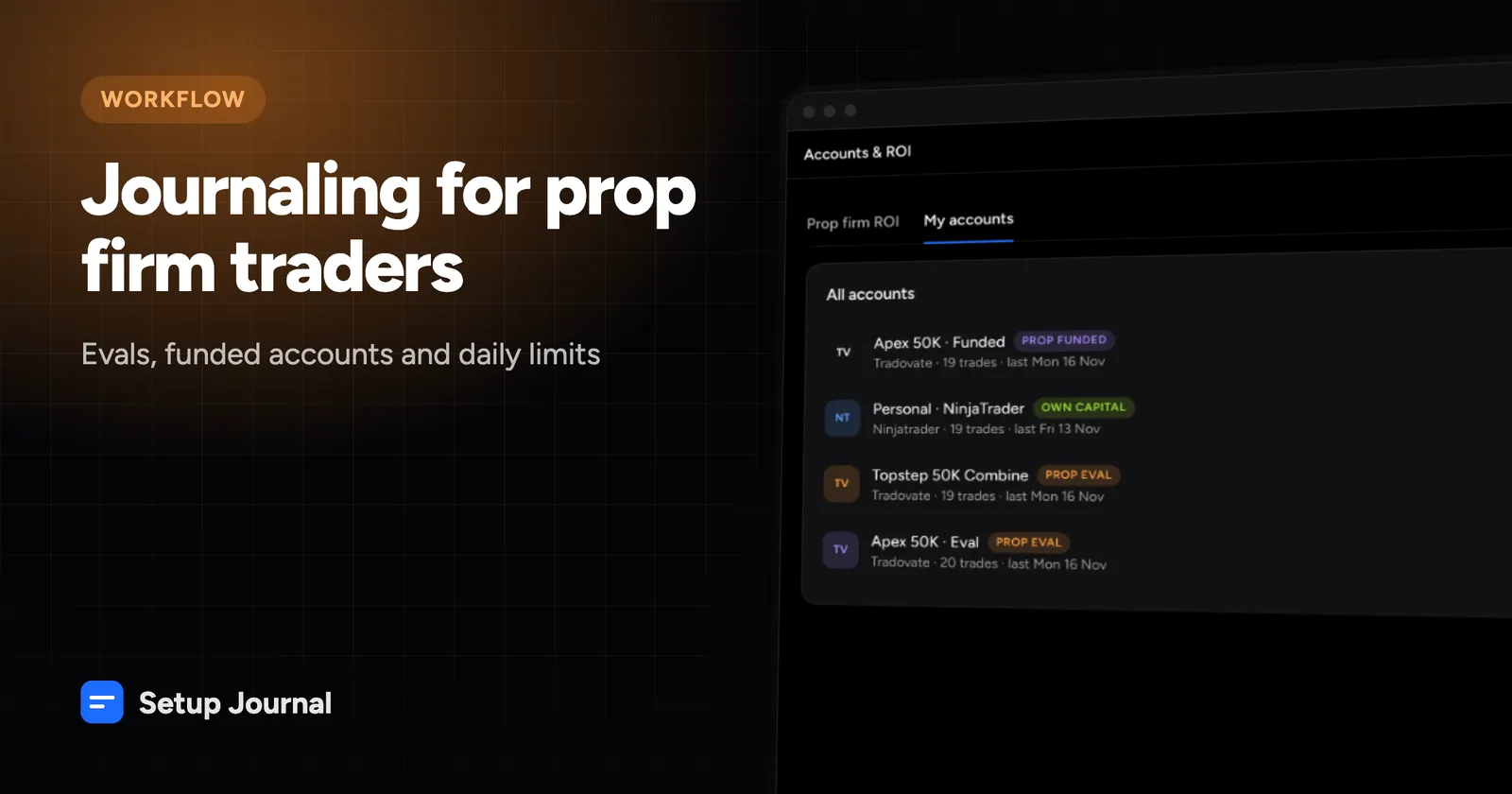
Journaling for prop firm traders: evals, funded accounts and daily limits
Prop firm trading adds rules a normal journal ignores: several accounts, daily loss limits, drawdown and consistency. How to journal so you pass more evals and keep funded accounts longer.
· 2 min read
Prop firm trading is a different game from trading your own account. You might have three evaluations and two funded accounts running at once, each with its own drawdown, daily loss limit and profit target. Usually you blow an account because of a rule, not a bad setup.
A journal for prop trading needs to answer a few extra questions. Here’s how to set one up.
Keep every account separate
Each account has its own rules and its own history, so journal them separately even when you trade the same idea in all of them.
- One account per account. Don’t merge your eval and your funded account into one P&L. You need to know which one is close to its drawdown limit.
- A combined view too. Seeing everything together tells you how your trading is going overall, as long as you remember that copied trades are counted once per account.
- Name them clearly. “50K eval #3” beats “Account 73829104”.
Journal the rules, not just the trades
Most prop accounts fail for one of three reasons:
- The daily loss limit. One bad morning, then revenge trades to get it back.
- The trailing drawdown. A good run raises the floor, then a normal losing streak hits it.
- Consistency or minimum-day rules. Too much of the profit on one day, or not enough trading days.
You can’t change the rules, but you can catch the behavior that breaks them. Tag it as a mistake every time:
- Revenge trade: taken to make back a loss, not because of a setup.
- Oversized: more contracts than your plan.
- Moved stop: let a loss run past your planned risk.
- Traded past limit: kept going after your own daily stop.
After a few weeks, the Setups page tells you exactly what each of these costs. That’s usually the difference between passing and failing.
A pre-market checklist
Before each session, write down three things. It takes thirty seconds:
- Today’s maximum loss for each account, from its rules and where its drawdown floor is.
- The setups you’ll trade today, and nothing else.
- The number of trades after which you stop.
Put it at the top of the day’s journal page. Then, after the session, check the “followed plan” box honestly.
Review after every session
Don’t save the review for the weekend. A rule break that cost you the eval needs to be looked at before you trade again tomorrow:
- Import the day’s fills and screenshots.
- Tag every trade: setup, and mistake if there was one.
- Write two lines on the day page: what went right, and what you’ll do differently.
Fees add up faster across accounts
Running five accounts means five sets of commissions and exchange fees on every copied trade. On micros those fees are often around $1.50 to $2.00 per contract per round trip. Make sure your journal includes all of them, not just commission. See why your journal P&L doesn’t match your broker.
Setting it up
In Setup Journal, every account in your Tradovate, NinjaTrader or CSV exports becomes its own account automatically, with its own balance and P&L. The day page starts with your pre-market checklist, mood and followed-plan fields. The mistake tags show exactly what each habit has cost. It’s free, and it works with the platforms most prop firms provide: Tradovate, NinjaTrader and Rithmic-based setups.