Prop firm ROI: how to tell if prop firms are paying you, or you're paying them
Payout screenshots show the gross. Your prop firm ROI shows the truth: every evaluation, reset and activation fee against every payout. How to calculate it, what's a good number, and how to track it.
· 2 min read
Scroll any prop trading Discord and you’ll see payout screenshots. You won’t see the receipts for the evaluations that came before them. That missing column is why so many prop traders feel like they’re winning while their bank account says otherwise.
The fix is one number: your prop firm ROI.
What prop firm ROI means
Prop firm ROI is the return on everything you’ve spent on prop firms:
Prop firm ROI = (total payouts − total costs) ÷ total costs
Costs are every evaluation fee, reset fee, activation fee and monthly data or platform fee you paid a firm. Payouts are the money that actually reached your bank account, after the firm’s split.
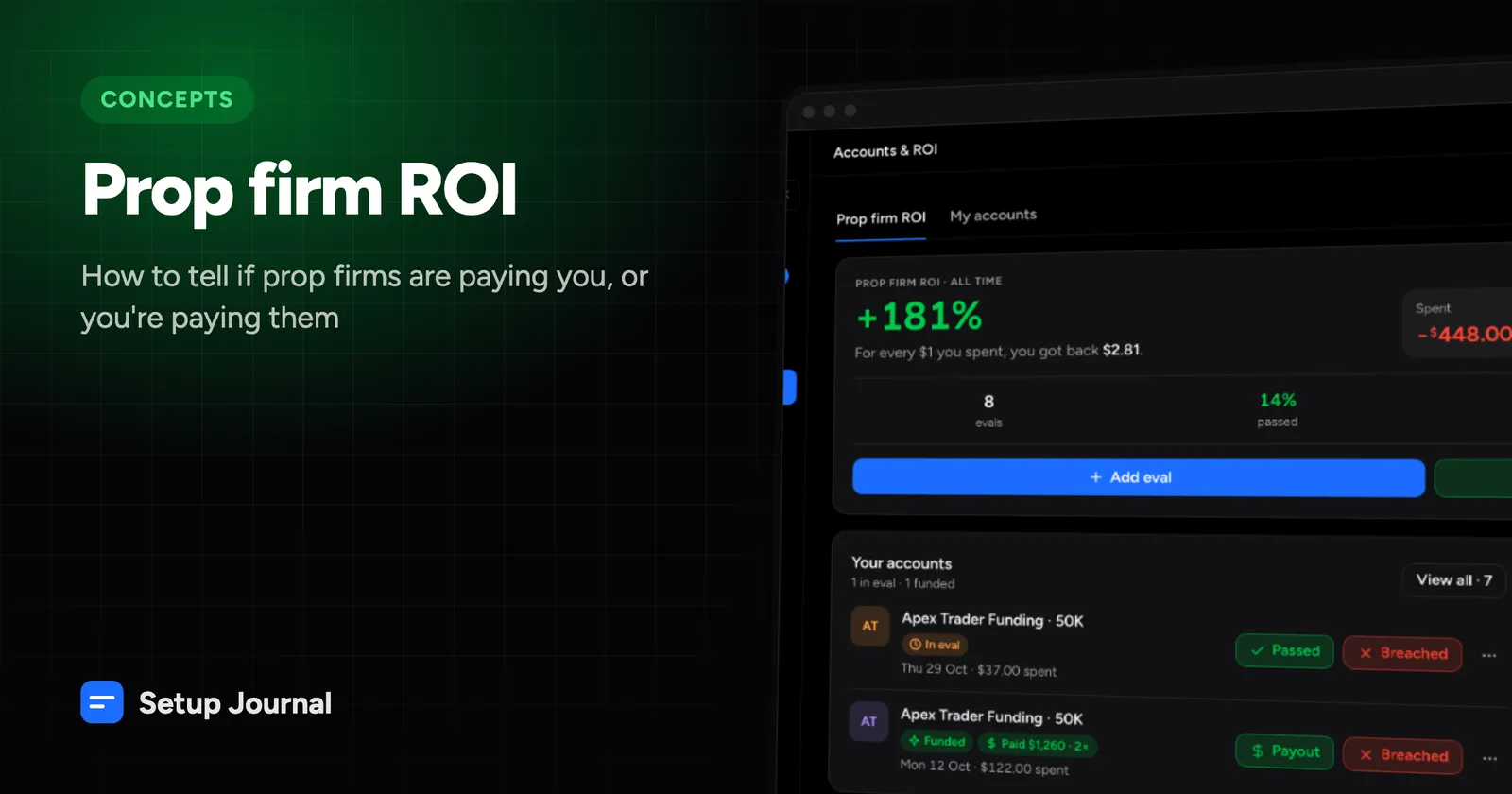
A worked example:
| Amount | |
|---|---|
| 8 evaluations at $37 to $122 | $448 |
| Payouts received (2) | $1,260 |
| Net | +$812 |
| Prop firm ROI | +181% |
Put differently: for every $1 spent, $2.81 came back. That’s a business. Flip the numbers and it’s an expensive hobby, no matter how good the payout screenshot looks.
Why your gut gets this wrong
- Fees are small and frequent; payouts are big and rare. A $37 eval doesn’t feel like much. Fourteen of them is $518.
- Resets hide. A reset feels like a second chance, not a second purchase.
- Funded doesn’t mean paid. Many funded accounts breach before their first payout. Passing feels like winning; only the payout is.
- Activation fees come after the win, so they get mentally filed under “celebration”.
The numbers to track alongside ROI
ROI tells you whether it’s working. These tell you why:
- Pass rate: evals passed ÷ evals bought. Below 1 in 5 usually means a risk problem, not a strategy problem.
- Funded to paid: how many funded accounts reached a payout. This is where most money is lost.
- ROI by firm: one firm’s rules may suit you far better than another’s.
- Average return per eval after all costs: the price of one attempt, in plain dollars.
- Longest dry spell: the longest stretch between payouts. Budget for it.
How to track it without a spreadsheet
In Setup Journal, the Prop firm ROI tab is the first thing you see under Accounts & ROI:
- Press Add eval: firm, size, price and how many you bought.
- When one passes, tap Passed. It becomes the funded account, keeping one history from purchase to payout.
- Tap Breached when one blows. Add resets and activation fees from the row menu.
- Press Add payout when money lands.
The page shows your ROI, what every $1 brought back, pass rate, results by firm and a reality check with your dry spells. It’s free, like the rest of the journal. See it with sample data in the guide.
What’s a good prop firm ROI?
There’s no official benchmark, but a few honest rules of thumb:
- Below 0%: you’re paying the firms. Stop buying evals until your pass rate improves on a single account.
- 0% to 100%: it’s working, barely. One bad month can erase it.
- Above 100%: every dollar spent came back doubled. Now protect it: the next step is consistency, not more accounts.
Whatever your number is, knowing it beats guessing. Most traders who track it for a month change how many evals they buy.